Meet Pax
Pax comes to you at the curb. Before anything else, it asks what would help today: walking at your pace, carrying a bag, bigger text.

By 2026, research shows that over 11 million American seniors face travel-limiting disabilities. An AI-powered robot and app companion designed to help them navigate airports independently.
Pax is an airport companion for older travelers: a small robot that walks beside you and carries your bag, and an app that tells you one simple thing at a time.
Pax comes to you at the curb. Before anything else, it asks what would help today: walking at your pace, carrying a bag, bigger text.
A short looping clip, like an in-flight safety video, shows exactly how the bag clips on. Pax locks it; only your phone can unlock it.
A live map of the whole concourse. Pick a café or a restaurant and Pax plans the walk, with the closest restroom, water and seats one tap away.
One instruction at a time, in large type. Lost your bearings? “Where am I?” shows your spot on the route, then takes you straight back to the same step.
While you’re inside, Pax waits outside with the bag locked on. If anyone tries to unclip it, your phone tells you, and help is one tap away.
“I need to rest” is always on screen. Pax waits beside you, says how long until boarding, then walks you the rest of the way.
70% of these seniors are forced to reduce their daily activity due to physical barriers. Beyond elders, many people with mobility, vision, hearing, or cognitive challenges find airports stressful to navigate: crowded, overstimulating, and tech-heavy.
Our team selected this topic driven by curiosity to explore how design could support the independence of elders and anyone with mobility challenges.
Elder travelers are guided by Pax: a calm, pet-like companion offering simple, landmark-based directions, energy-aware routing, and transparent explanations.
Austin, TX. Computer science background with robotics modeling experience.
10+ years in enterprise product design.
Pharmaceutical company improving healthcare access in Africa.
What we learned: edge cases matter most (crowds, urgency, device failure). Simplicity comes from controlling information, not removing it. Accessibility must be built in from the start, and trust and reliability matter more than features.
An AI-powered travel companion that reduces stress and confusion for elderly travelers, built for accessibility, confidence, and independence.
Concept 3 was the clear favorite: "thoughtful and safety-oriented," and helpful beyond elderly users. "People still struggle with navigation even with apps."
Responses skewed younger and tech-fluent, so we expanded criteria to anyone with mobility constraints. Only George met the original 65+, low-tech-exposure profile.
15 responses and 6 recruited
LinkedIn · X · Facebook · Reddit · Instagram
6 participants
30-min moderated sessions
Remote via Zoom · think-aloud
3 core tasks
Onboarding · Wayfinding · Amenities
Record → Tag → Map

Former Qatar Airways flight attendant, high airport fluency.

Travels ~once/year; very low tech exposure; familiar with SFO.

Startup CFO in San Francisco.

International student; moderate tech use; travels twice/year.

Recently injured arm; travels often, usually with someone.

Stay-at-home mom, usually travels with children.
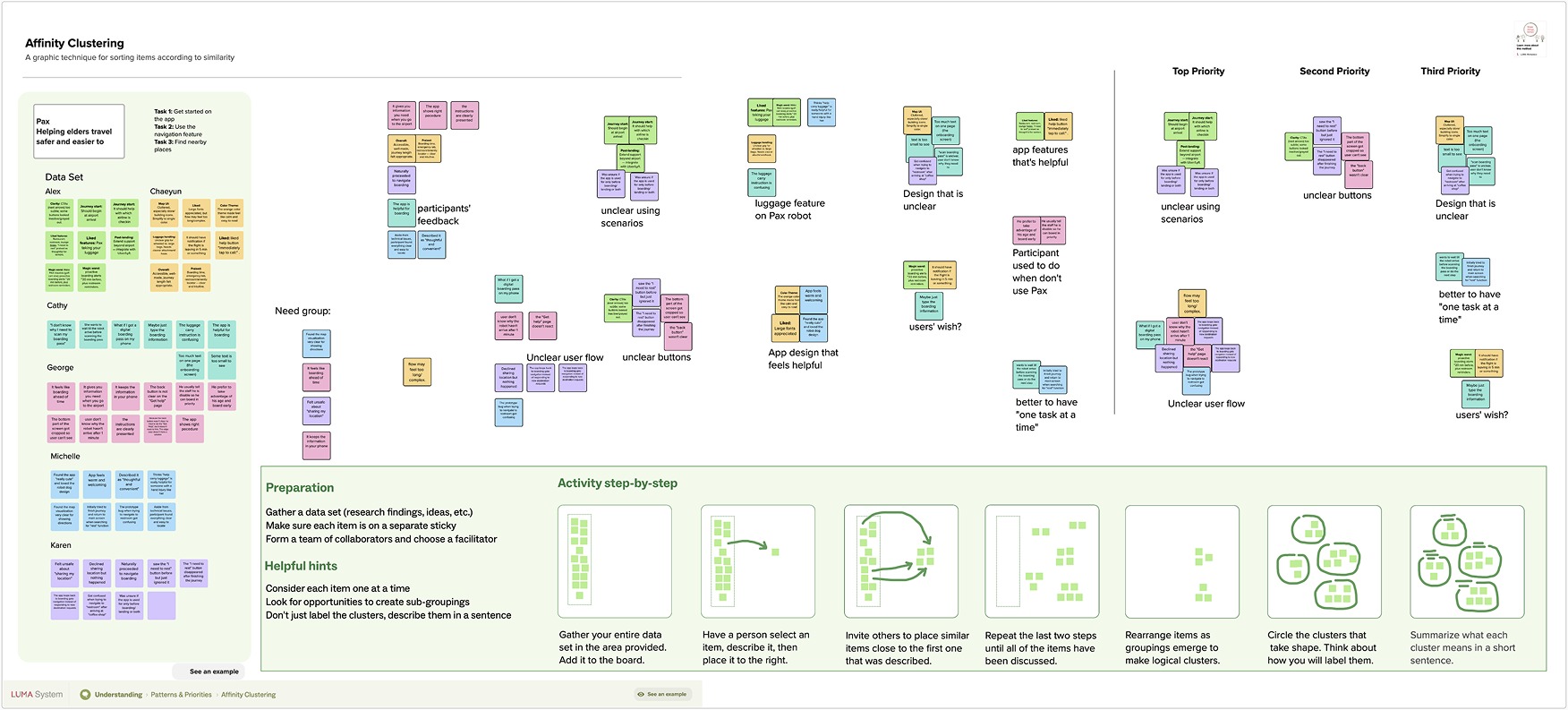
We tagged every session and clustered the notes, then ranked the clusters by how often and how badly they blocked people:
We used the AI tool Condens to help sort out the interview contents.
You've just arrived at SFO with the app downloaded. Show how you'd begin.
Your flight is in three hours. Use the app to get to your gate.
Find something to eat or somewhere to sit nearby.
"The app is helpful for boarding."
Cathy"Thoughtful and convenient."
Michelle"Especially if I'm going to an airport now, because my hand got a very serious injury, this can really help me."
Michelle"I don't know how that robot can handle, or how the robot can have a hook so that it could put the luggage onto Pax."
ChaeyeonDesirable, but participants couldn't picture the handoff: what luggage Pax accepts and how it attaches.
“All the call to action buttons were located on the bottom and what I see here is I need to rest, which is, in gray, so it doesn't look like it's activated”
Alex
None of our six participants noticed it, and it disappeared after the journey ended. A stronger color aiming for WCAG AAA contrast (7:1) will make it stand out for older eyes.
Change it to "Decline and exit the app," or ask again before the next navigation step, so edge cases are handled.
Users with higher cognitive load struggle with more than one action at a time. Sequence tasks so each step resolves before the next.
Text is too dense and too small for elderly readers. Break instructions into simple, action-led steps, with body text at 18pt minimum.
We assessed product-market fit with Sean Ellis's framework: 40% or more "very disappointed" responses to losing the product signals PMF. 14 people completed the survey, though the sample skews younger and more design-adjacent than Pax's elderly target users.
At 14.3%, Pax hasn't reached the threshold yet, but the large "Somewhat disappointed" group signals potential.
Pax's primary value is Effortless Way finding: turning airport anxiety into safety and physical ease.
Physical Accessibility helps users manage their health and energy during travel.
Getting there on time and knowing what’s nearby matter most; safety comes right after. These three lead the product.
Ship a v1 accessibility kit (adjustable text, high contrast, screen-reader support, simplified navigation), plus mobility-aware routing, voice + visual guidance, and a "Personalized Needs Profile" at onboarding.
Focus on airport wayfinding and transit stress; defer general travel. Invest in real-time reliability and offline maps and boarding passes.
Hold pricing tests until those ship, then re-test willingness to pay with elderly travelers, who feel the pain Pax solves most.
Our biggest insight was that the problem wasn't simply "getting lost," but older adults' fear of becoming a burden while traveling alone. That insight shifted Pax from a navigation tool into a confidence-building companion.
The biggest challenge was recruiting elderly, low-tech participants; many were younger proxies, which limited how far we could validate trust and learnability. Early versions of Pax also tried to do too much (navigation, health monitoring, and luggage) before we learned to narrow the MVP.
Personally, I grew through leading the team: arranging activities, facilitating testing, recruiting participants, and guiding the UX direction. Next time, I would recruit representative elderly users earlier and prototype the physical interaction between Pax and the user.
©2026 Amanda Yu. All rights reserved